
What is a brand’s tone of voice, exactly?
If branding is your visual identity, tone of voice is your verbal identity.
It’s about how your customers, users and other important people feel when they interact with your products and services.
Do they understand what you do, how you do it, and why?
Do they feel understood?
Do they know what you want from them?
Do they trust your organisation to deliver on its promises?
Were they frustrated or alienated by something you said (or didn’t say)?
Lots of organisations have a tone of voice document. That is necessary, but insufficient to deliver and maintain content in a way that serves users best.
It’s only one of the steps toward building stronger relationships with the people who interact with you.
Who creates the tone of voice?
In our experience, most tone of voice documentation is delivered as part of a visual identity brief by branding teams and agencies.
In our opinion, your users and customers – not brand custodians – should have the most influence over your tone of voice.
We believe the right approach to building a brand tone of voice is to take a language-based user experience perspective. It’s not a branding exercise
The extent to which this is true varies by industry. But on the whole, most of the words you use will be for helping your customers use your products and services.
What a brand tone of voice is NOT
To understand what makes a useful tone of voice, it’s important to identify and throw away some of the most commonly stated objectives for developing a tone of voice.
-
- Flattering: Tone of voice is not simply a collection of adjectives describing how you would like your brand to be perceived. Your users and customers will decide how they perceive you. Please develop your tone of voice from the assumption that you can suddenly become ‘inspirational’, ‘equitable’ or ‘admired’.
- Consistent: Many organisations believe that their tone of voice must be “consistent across all channels” to be effective. This isn’t true. Imagine you’re a bank customer. Would you expect to be told that your mortgage application has been declined in the same tone of voice as being told that your latest statement is ready?
- Complex: You should never talk down to customers, but you should keep in mind the following statement from the UK’s National Health Service (NHS): “The majority of adults in England are in the 11-14 year old reading age group.” In practice this means your tone of voice should favour uncomplicated, plain language. You must deliver the content in short sentences that have simple structures.
Bad tone of voice examples
By looking at what brands do wrong, you can get a sense of what standards you might set.
One of the most common tone of voice mistakes brands make is, simply put, acting daft. They think this makes them relatable.
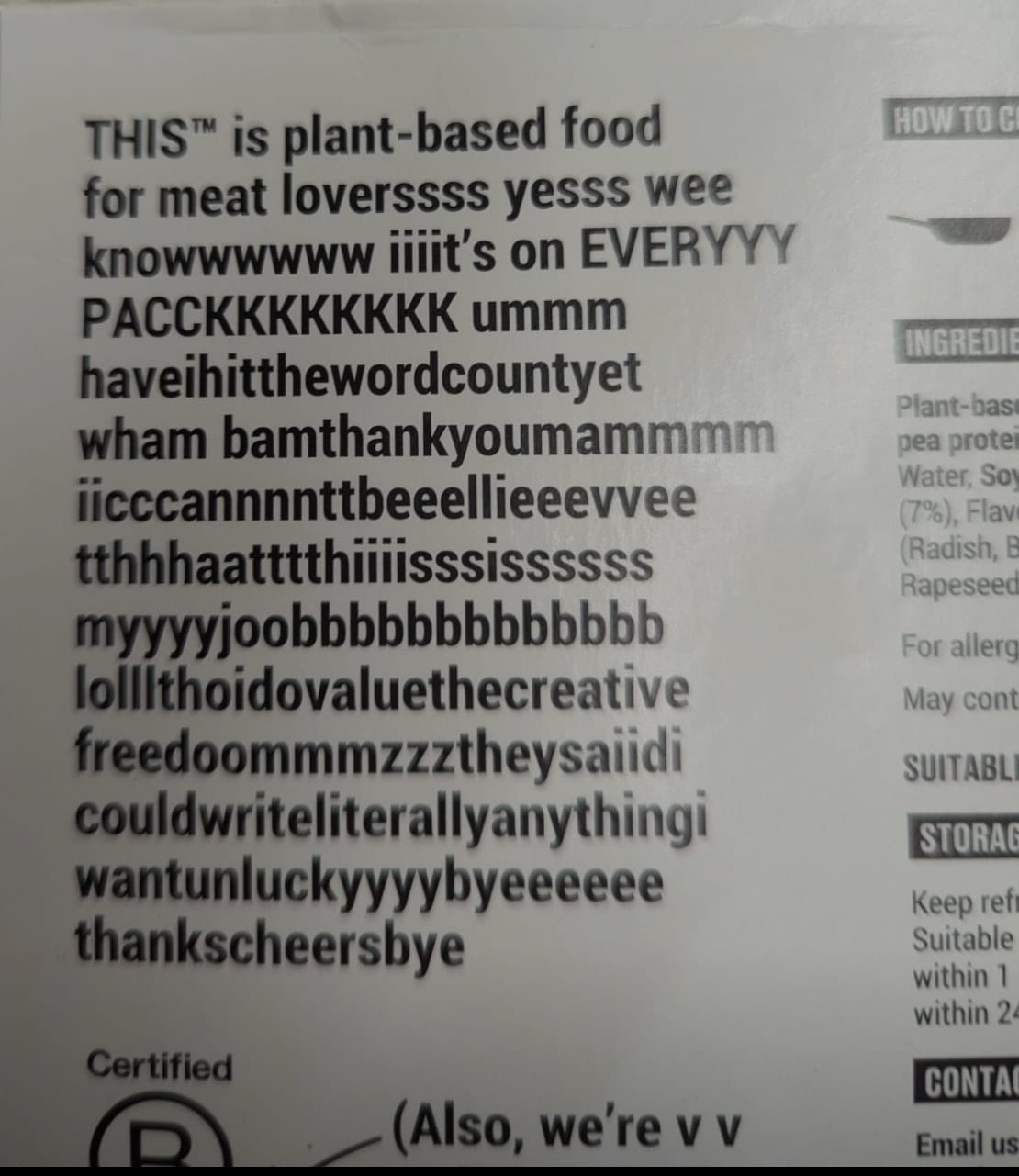
Example of a very bad tone of voice
Taken from THIS™ plant-based food packaging
Look at the packaging copy below.
Who does this serve?
It serves the brand, not the user.
It’s a form of signalling. “We are so confident that you will love our product that we are going to waste valuable packaging real estate on this garbage.”
Imagine you’ve bought this product, and want to know the ingredients or the use-by date, but you can’t find that information quickly because it’s in a tiny type to make room for this garbage.
You may have seen examples of ‘wacky’ or unorthodox copywriting presented as ‘tone of voice.’ It’s quite common on food packaging. This is attention-seeking nonsense and should be disregarded. Such behaviour has no benefit to the user and only serves as LinkedIn content for the brand to promote how fun they are.
Another example of a bad tone of voice
Taken from a sign at Euston Station, London. Photo taken by Paul Lucas.
This is an error message. Part of the product or service has failed. Yet this sign gives the user no useful information, such as where the nearest working lift is. It is twee and unserious. The language is hard to understand, especially for people for whom English isn’t their first language. And the tone completely ignores the context.
The context is that the customer is about to be inconvenienced. If that customer is in a rush, or has a mobility impairment, this inconvenience may cause them to miss their train.
The tone is ‘aren’t we fun?’.
Tone of voice is about user experience
It bears repeating. In the majority of cases, tone of voice should be a user experience endeavour. A thoughtfully developed brand tone of voice, well implemented, should achieve the following things:
- Make people feel understood
- Make it easy for people to understand you
- Help people complete tasks on your website and app
- Reduce frustration with challenging or ‘boring, but important’ tasks like Know Your Customer disclosures)
- Help users build trust with your organisation
- Make your products and services memorable
- Make your values clear and unambiguous
- Communicate how you are meaningfully different
Your tone of voice should reflect the values of your brand and those of the people within your organisation. It should acknowledge the anxieties and aspirations of your audience (customers and users) and account for the context in which they expect to engage with you.
Good tone of voice examples
Tone of voice serves different functions according to context. Applying a universal tone of voice to all scenarios is bad for user experience.
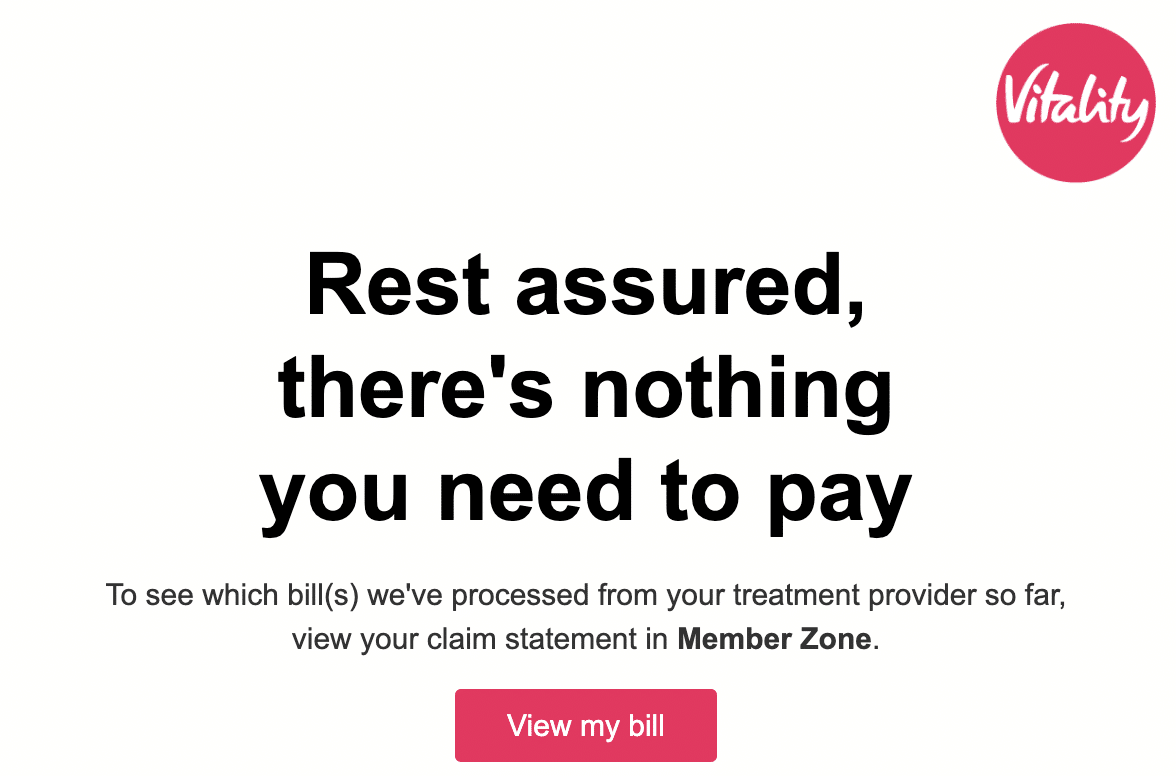
Example of a reassuring brand tone of voice
Taken from a Vitality Health customer email
Why is it good?
The first thing you want to understand when you get an email about a bill is whether you need to pay anything.
The easy thing to do here is to tell the customer their bill is ready. The more complicated (but correct) thing to do is to customise the message according to whether the customer has already paid or not. Then reassure them that there’s no action required.
Digital strategist Simon Gray calls this “active negativity”, which nicely sums it up.
Example of a trustworthy brand tone of voice
Taken from a Monzo customer email
Monzo is rightly famous for having an excellent tone of voice. This email demonstrates why. It is easy to understand, jargon-free and sets out clearly the customer’s rights and options, including what happens if the customer does nothing.
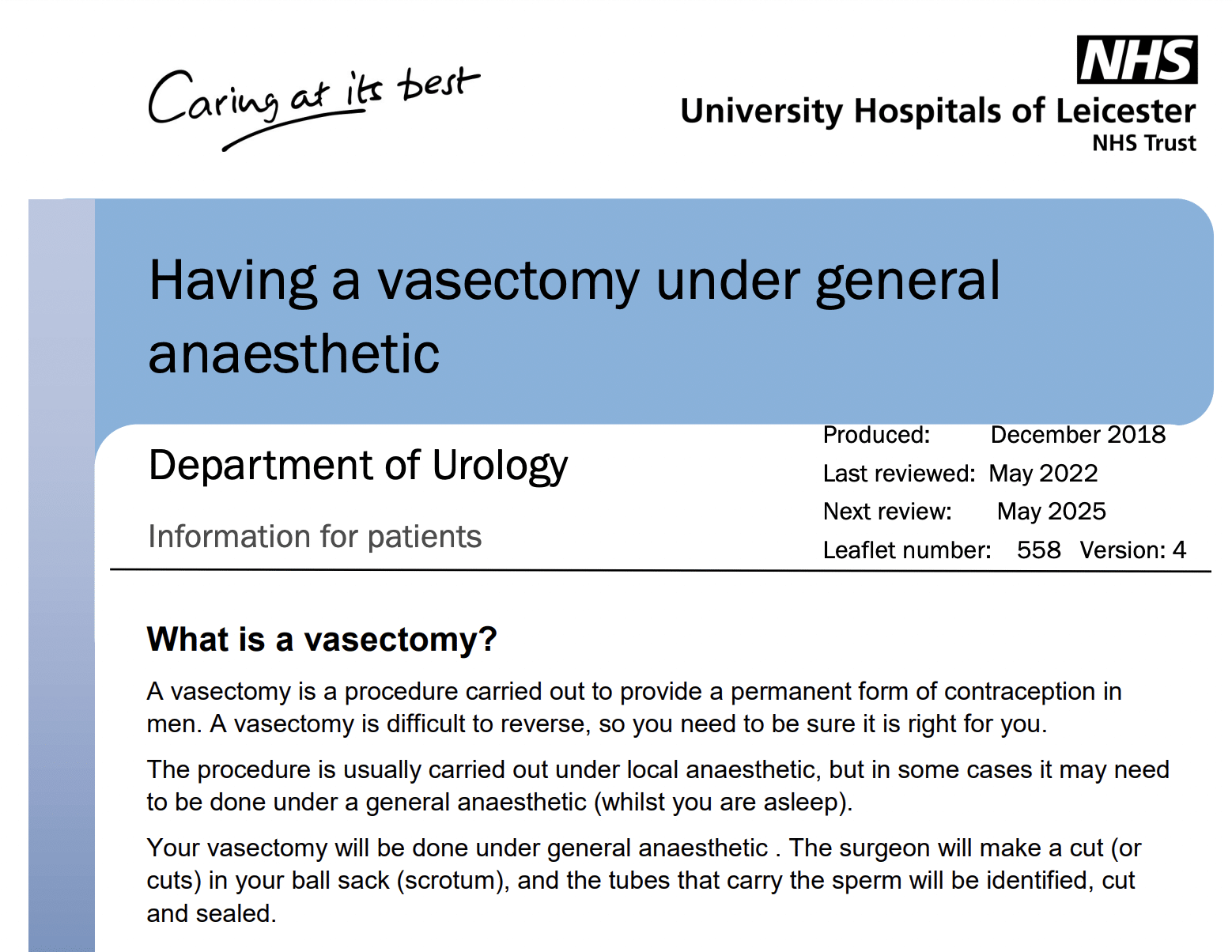
Example of an accessible tone of voice
Taken from an NHS webpage
This web page from NHS Leicester is excellent. You might first wince when you read the words ‘ball sack’. It sounds crude and unscientific. But if we remember that most people using the NHS have a reading age of around 14, it makes sense. This is more likely to match the language men use to discuss their body.
How to build an effective tone of voice framework
This is not a step-by-step guide to creating and implementing your brand tone of voice. It’s a five-step exercise to get you started in the process.
-
Audit inbound customer and user communications
Why?
Your tone of voice should reflect the way your customers and users speak. This exercise should highlight the differences between how you speak and how your customers speak. Some banks say ‘funds’, customers say ‘money’.
How?
Depending on the type of organisation you are working for, the best communications channels to explore will vary. We’ve listed below some examples of inbound communications in order of how valuable they could be.
Customer service calls
Invest some time listening to and reading what your customers say and how they say it when they interact with your brand. A good tip is to use an AI transcription tool like Otter or Fireflies.AI to transcribe call recordings so you can look for common patterns.
Search for phrases like:
“How do I?”
“Why can’t I?”
“I just want to…”
Customer service chatbot conversations
These transcripts will quickly reveal the pain points and anxieties that your customers and users experience when they use your products or services. Look out for common themes and document them.
Reviews
Reviews should always be taken with a pinch of salt because there is inherent selection bias: people who leave reviews are not particularly representative of your user base. They are typically at one end of the satisfaction spectrum. But there will be some common themes to dig out.
Search analytics data
Knowing what questions people ask before discovering your website is really useful in helping you understand exactly what solutions they are looking for.
Once you’ve collated enough information, you’ll be able to cross reference the language you use with the language your customers use. Look out for discrepancies.
Speak to the people closest to your customers
If you’re a bank, this is probably a cashier or a customer service advisor. If you’re a car brand, this is probably someone who works in the service centre or in a showroom. If you’re a health care provider, this is probably a doctor. The point is to get a clear understanding of the following:
- Common customer language
- Common customer anxieties
- Common customer aspirations
Mini case study:
When Essential Content helped an insurance brand refresh its tone of voice we discovered that the language on the website and in customer emails was radically different to the language customers used when interacting with the product.
The web content was big on mission, purpose and ideals. The customers didn’t relate to this. So we highlighted in the language that the customers talked about themselves, like
There was also a major discrepancy between the language used in the online claims journey and how customer service staff spoke to policyholders.
The goal for the client was to encourage as many customers as possible to submit their claims online. This might be fine for a customer on their driveway who has noticed a scratch to the paintwork. It’s not particularly suitable for a customer who is on the hard shoulder of the motorway and worried about what to do next.
To solve this problem, we asked the client to accept that there will always be customers who need to call them and to make that easy. They agreed and introduced scene-setting content that gave the users two statements to choose from.
“I am in a roadside emergency and need help”
“I want to start a claim online”
-
Select between no more than three points of meaningful differentiation
What makes your organisation genuinely different?
You might need some time to figure this out. You are not allowed to include things like ‘integrity’ or ‘we put customers first’ because that’s not meaningfully different and other brands in your industry probably say this already.
Are you the biggest, fastest, slowest, newest, oldest, cheapest, most expensive, best, second best?
Where do these superlatives intersect with other values?
For example, we have a client that is the best in the world at automating optical character recognition into digital workflows. It’s not glamorous, but it’s meaningful to their customers.
Here are three good examples of being meaningfully different.
A hotdog and soda costs $1.50
In America, a Costco hot dog and soda combo meal costs $1.50. It has since 1985. When the new CEO tried to (reasonably) adjust the price in line with inflation, the founder Jim Sinegal told Costco CEO Craig Jelinek “if you raise the (price of the) hot dog, I will kill you. Figure it out.”
1% of sales to environmental causes
Since 1985 the outdoor clothing Patagonia has donated 1% of sales, more than $89 million in total, to environmental causes. They have a transparent supply chain and create resilient products that last, benefiting the consumer and the environment. In 2016, they closed stores to allow American employees a paid day off to vote in the presidential election.
Patagonia’s European marketing director Alex Weller understands the difference between authentic social purpose – the expensive kind that requires dedication and ideas – and the other kind, marketing campaigns dressed up as a social conscience. “You can’t reverse into a mission and values through marketing. The organisations that are struggling with this are probably the ones that are thinking about marketing first.”
Giving ex-prisoners a second chance
UK retailer Timpsons offer a diverse array of services, key-cutting, shoe repairs and barbering to name just three. But most people in the UK would tell you about their programme of employing people who’ve been in prison before they told you about their excellent customer service or competitive prices.
-
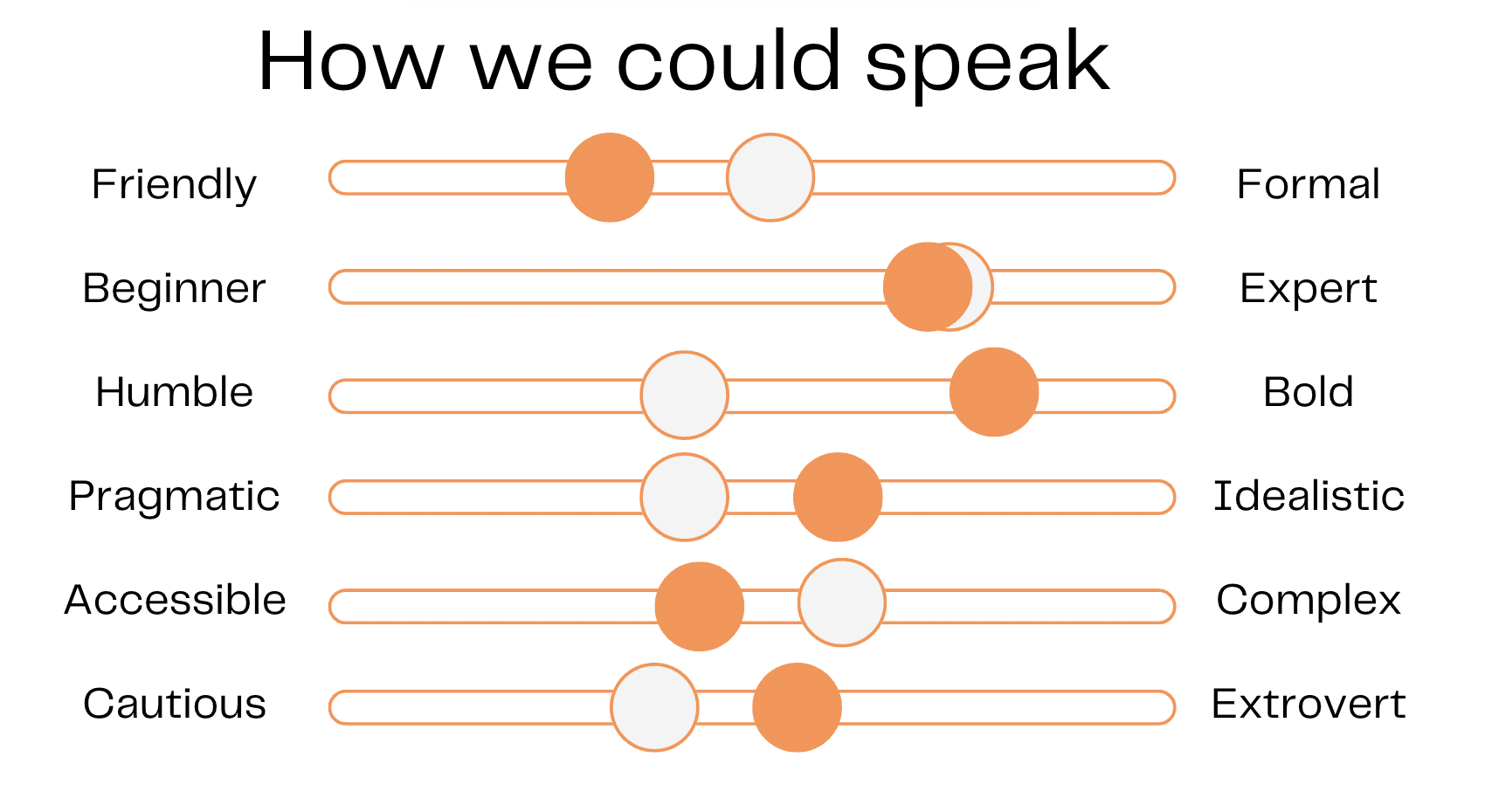
Do the ‘mixing desk’ exercise
Imagine you’re a record producer for a moment. You’re at the mixing desk trying to make the song sound as good as possible. You can’t turn everything up to 10 or the mix will sound like mush. No particular sound will stand out. If you want to add bass, you need to dial down other frequencies to make space.
Think of your tone of voice similarly. To sound friendly, you must sacrifice formality.
This works best as a group exercise. Give each person in your tone of voice session the opportunity to say to what extent the tone of voice. Compile everyone’s answer, then start making difficult decisions. Do not average out everyone’s opinion. If people disagree, discuss it and figure out who is right. If all of the sliders sit in the middle, the exercise won’t work.
4. Jargon amnesty
Go through a selection of public content. This might include emails, web pages, social media posts, product literature, letters or packaging. You will identify words, phrases and terminology that should be, at most, for internal use only.
Banks are a great example that we touched on earlier. Banks are still saying things like ‘remittance’ and ‘cleared funds’ while their customers say things like ‘payments’ and ‘available money’.
Be ruthless. Decide which language can be simplified, and agree as a team on a single word or phrase that you will use universally in its place. Then decide on which language is necessary for internal use, for example some technical or legal language fits the bill, and agree as a team on which simpler public-facing alternative you can replace it with.
5. Remove interchangeable words and phrases
Interchangeability kills comprehension. But writers like to ‘mix it up’ to address their own boredom. Your users will never read enough of the content you produce to get bored of certain words or phrases.
Here are some commonly interchangeable words and phrases that you might consider removing.
| Funds | Money |
| Purchase | Order |
| Revenue | Income |
| Expenses | Costs |
| Employee | Staff |
| Client | Customer |
| Contract | Agreement |
| Profit | Earnings |
| Strategy | Plan |
| Venue | Location |
Bonus exercise: Select a dream company spokesperson
This exercise is good because it’s fun. And it creates a useful debate about how your brand should communicate. It’s also easy.
Start with this question: If money were no object, which public figure would be the best spokesperson for our business and why?
You’ll get lots of different responses and it’ll be interesting to revisit the answers in a year’s time to see how things have changed.
We often use this question to get the creative juices flowing in our tone of voice design sessions. And we’ve actually kept track of the answers. Elon Musk isn’t as popular as he used to be.
Implementing your brand’s tone of voice
Implementation is where the magic happens. Without good implementation and a comprehensive writing system, tone of voice work is a waste of everyone’s time.
Implementation is also the trickiest part. You’ve done the creative work and now need to embed the outcomes into all communication channels.This requires discipline, systems thinking and a commitment to continuous improvement.
If you’d like help building and implementing your tone of voice, please get in touch.



 Step 3a. Test the values
