
Good support content can turn a frustrated user into a loyal customer, and keep support costs down. But AI is changing the way it’s created and used. Your next reader might not be a customer at all. Support content now trains your AI and gets read by AI agents your customers send in their place. In this article, we’ll look at the principles behind clear, reliable support content, and how AI is redefining the way we create it.
Contents
- What customer support content is
- Why it’s different from other content
- Principles for writing it
- AI and customer support
- Checklist
What is customer support content?
Customer support content is everything that helps customers understand a product or service, get value from it and solve problems along the way. It lives in help centres and FAQ pages, inside the product as tooltips and walkthroughs, and in conversations with support, whether with a person or an AI agent. Great support content helps bring customers in and keeps them coming back.
How is support content different from other content?
People often turn to support content when something has already gone wrong. Their payment didn’t go through, their order is late, or they can’t figure out how to do something. They arrive confused, frustrated or even annoyed, and the content is the company’s chance to put things right. If the help is smooth, the customer often comes away trusting the company more than before. If it isn’t, they may start looking elsewhere.
For support content, success means time saved. A marketing blog post does well when people get to the end of the page and click the call to action. Support content is the opposite: it works best when it gets readers back to their task as quickly as possible.
8 ways to create great support content
1. Anticipate questions
Good support content answers questions before people have to ask them. Think about what customers most often want to know, and what they might need next, and design your support content accordingly.
2. Make the answer obvious
Support content needs to be scannable, so people can find the answer at a glance. Clear headings, short paragraphs and a table of contents for longer articles let people get straight to what they need. Offering the same help in different formats, like an article, a video or a chat, lets each person get the answer in the way that works best for them.
3. Be specific
Answers should be clear and leave no room for misinterpretation. Ambiguous wording makes people hesitant and usually leads to more questions. A common example is cancelling a trial: it’s often unclear whether access ends straight away or after the trial. Good support content spells out the exact conditions and keeps it brief.
4. Set clear expectations
Support content should never leave people wondering “now what?” If the problem can’t be solved right away, tell them what happens next, who’s doing it and when. Someone who’s left guessing is more likely to get frustrated, chase support for updates or give up altogether.
5. Match your tone
When people reach for support, assume they might be feeling frustrated, and write for that. Acknowledge the problem, stay calm and matter-of-fact, apologise once if you need to, and move on to resolving the issue.
6. Be honest about limits
Tell people the truth, even when it’s not what they want to hear. You might not always know exactly when a problem will be fixed, and it’s tempting to hide that behind vague, reassuring wording. But people notice, and it frustrates them more than a straight answer would. “We don’t know yet, but we’ll update you by Friday” is more helpful than a polite reply that doesn’t say anything.
7. Make it easy to reach a person
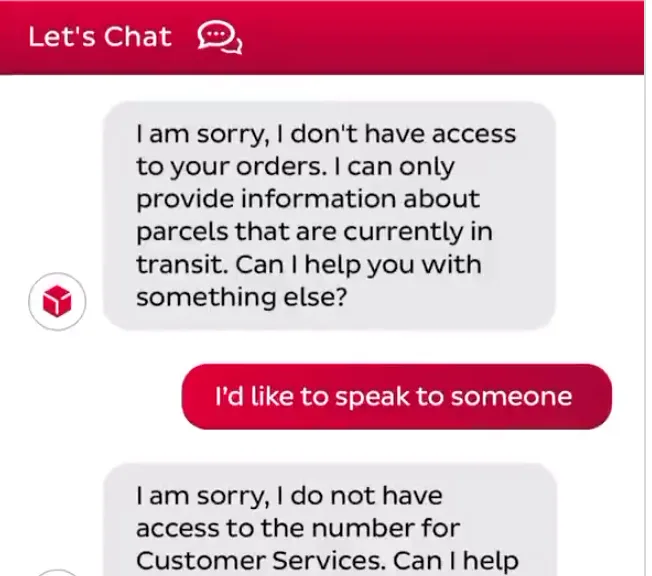
Not every problem can be solved with an article or a chatbot, so people should always be able to reach someone from your support team. When you hand someone over, try to pass on what they’ve already said, so they don’t have to start again.

8. Stay consistent across channels
The same information often lives in several places: the help centre, the product, the chatbot and your team’s saved replies. When they don’t match, it means more support questions, which defeats the purpose. Keep every source up to date.
What does AI mean for the future of support content?
AI agents on the front line of support
As AI reshapes the way we look for information, support content is taking on a new role. More and more companies use AI agents as the first point of contact with customers. These agents draw on the company’s support content to answer, so the quality of their answers depends directly on the quality of that content. If a page is outdated or two pages contradict each other, the AI may pick the wrong one and present it as fact, misleading the customer.
Until now, good support content had to be clear and accurate for the person reading it. Now there’s a second reader, AI, and it reads differently. Instead of going through a page from top to bottom, it pulls out the passage that seems most relevant to the question. So each passage needs to carry its full context for AI to pull out the right information.
What this means for your support content
This changes how you structure and format support content:
- Use headings that ask the question the way a customer would, and answer one question per section.
- Put the answer first, followed by any explanation or context.
- Make sure each paragraph includes its full context.
What’s next: agents talking to agents
Just like companies, customers are starting to use AI too. A customer looking for your refund policy may never even open your help centre. Search engines now show an AI-generated summary at the top of the results, built from several websites, and for many people that summary is the answer. In a 2025 Pew Research study, when Google showed an AI summary, users clicked through to a website in only 8% of searches.
Soon, some customers won’t contact support at all. Their AI will do it for them. Personal AI agents like OpenAI’s ChatGPT agent, Anthropic’s Claude and Meta’s Muse can already browse websites and fill in forms on their users’ behalf. Some go further: Instinct can work directly with a company’s support AI to sort out a delayed package or a confusing return policy. This means your content gets interpreted twice before it reaches the customer: first by your support AI, then by the customer’s own AI. Like in a game of telephone, something might get lost.
What this means for your support content
You won’t always control how your content is presented. Once it’s passed from one AI to another, your formatting and tone may not make it through, so the facts need to stand on their own. That gives you a new task: testing your content with AI, not just with customers at the end of a chat. Ask AI tools the questions your customers ask, and check whether the answers match what your content says.
Good support content helps people find the right answer quickly, and leaves no room for doubt. It’s what turns a frustrated customer into a loyal one, and it keeps your support team from answering the same questions over and over. None of that changes with AI. What changes is who’s reading. Your support content now has to work for the customer and for AI, and that means rethinking how it’s structured and formatted. Your next reader might not be a person, but the person at the end of the line still needs the right answer.